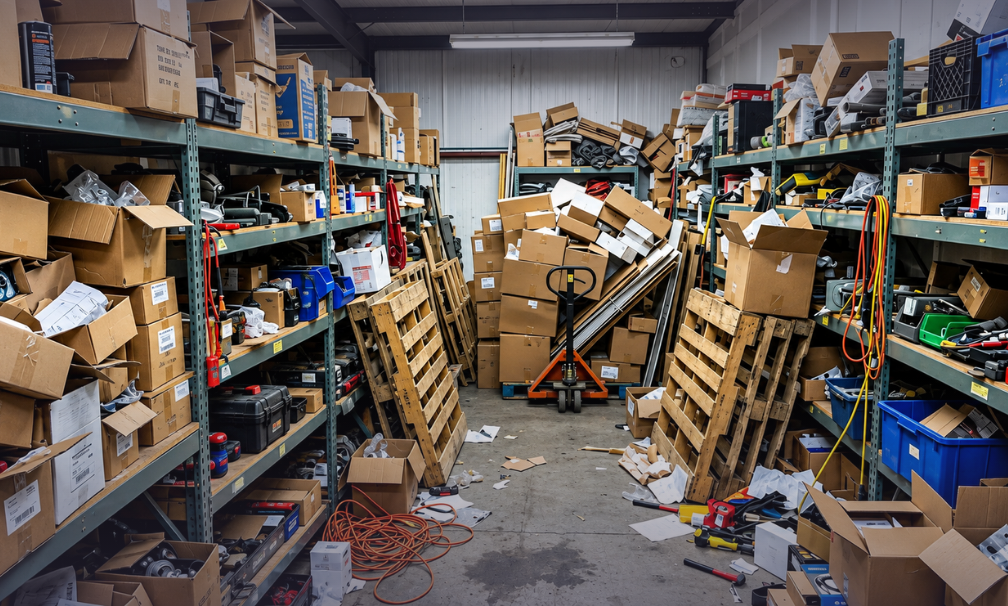
Ask almost any installation company how they manage their inventory, and chances are the conversation will quickly turn to the warehouse. How much stock is on hand? Are the inventory levels accurate? And where are the items stored?
But the reality is very different.
Materials are no longer confined to the warehouse. They can be found in service vans, on project sites, in temporary storage, or being returned from completed jobs. Every day, materials are on the move. That's why you're not managing inventory—you're managing the flow of materials.
Materials are constantly on the move
From the moment materials are delivered, they begin moving through your operation.
They arrive at the warehouse, are issued to a technician, loaded into a service van, used on a project, or partially returned to the warehouse. Sometimes they're immediately used again, and sometimes they end up sitting somewhere with no one knowing exactly where.
Every movement is an inventory transaction. If these transactions aren't recorded, your inventory gradually becomes less reliable.
The biggest problems arise between locations
Many companies invest heavily in keeping their warehouse well organized. Yet most inventory issues don't originate in the warehouse itself—they happen outside of it.
A technician searches for materials because it's unclear which service van they're in. Returned materials make it back to the warehouse but aren't registered again. Items are left behind at a job site while the system still shows them as being in warehouse stock.
The result is familiar: duplicate orders, stock shortages, time wasted searching for materials, and inventory discrepancies. Not because people are making mistakes, but because there's no clear visibility into the flow of materials.
Inventory management is about more than counting stock
An annual stock count provides nothing more than a snapshot in time. But as soon as materials start moving again, reality changes.
That's why effective inventory management is about more than knowing how many items you have. It's about knowing where they are, who's using them, and when they're being moved. Only then can you truly rely on your inventory data.
How BarTrack gives you complete control over your material flow
BarTrack was built around this principle. It doesn't just give you visibility into your warehouse—it gives you visibility into every location where materials can be found.
A warehouse, service van, project container, or temporary storage location can all be set up as inventory locations. Materials are scanned whenever they're moved, issued, or returned, keeping inventory records accurate and up to date automatically.
Technicians no longer have to search or guess where materials are. Planners know exactly what's available, and purchasers avoid unnecessary orders because they have complete visibility into the entire flow of materials.
More visibility, less waste
When you have full control over your material flow, many day-to-day frustrations simply disappear.
Technicians spend less time searching for materials. Planners can schedule work more effectively. Returned materials become available for reuse, and inventory discrepancies are significantly reduced.
The result isn't just a better-organized warehouse—it's a more efficient business where materials are used to their full potential.
Summary
Inventory management is no longer just about the warehouse. Every day, materials move between warehouses, service vans, job sites, and return locations. It's within these material flows that time-consuming searches, duplicate orders, and inventory discrepancies often arise. BarTrack gives you complete visibility into your entire material flow, so you always know where your materials are and can manage inventory with confidence and greater efficiency.


 Joelle Hablé : Aug 12, 2026, 10:35:56 AM