In many companies, there is one person who truly knows the warehouse. They know where the special fittings are that are only used a few times a year. They know which materials are still stored at the back of a rack. And they know that one box of electrical components isn't in location A, but was temporarily moved to location B.
To their colleagues, they often seem like a walking search engine—until one day, they’re not there.
Many companies don't realize how dependent they are on this knowledge. As long as everything runs smoothly, it doesn't seem like a problem. But the moment an experienced employee calls in sick, goes on vacation, or leaves the company, it becomes clear how much critical information exists only in their head.
That's exactly why more and more companies are choosing to support their warehouse operations with BarTrack, ensuring that essential knowledge is no longer dependent on a single person.
The knowledge is all in their head
Many warehouses have grown organically over the years. New materials are placed wherever there is available space. Racking is expanded. Temporary solutions become permanent. Over time, this creates a system that only makes sense to the people who work with it every day.
As long as the same employees remain, this doesn't have to be a problem.
But what happens when that experienced warehouse employee calls in sick, retires, or decides to work somewhere else?
Suddenly, it becomes clear that much of the warehouse knowledge was never documented. Where are certain materials stored? Which items are used most often? Which storage locations are still available? These are questions that are often answered only through experience.
The warehouse slows down without anyone noticing
The consequences are often greater than expected.
Technicians visit the warehouse more often to ask for help. Planners spend extra time searching for materials. Buyers reorder parts because no one is certain whether they are still in stock.
No one immediately sees it as a major problem. Yet small delays start to appear throughout the organization.
A technician spends ten minutes looking for materials. A planner double-checks an order. A buyer orders extra stock just to be safe.
Individually, these may seem like minor issues. But together, they cost an organization a significant amount of time and money.
Dependence is a risk
Many companies invest in machines, software, and processes to reduce risk. Yet warehouse knowledge often remains dependent on individual employees.
That is understandable. Experienced employees build up valuable knowledge over many years. But when critical information exists only in people's heads, it creates a vulnerable situation.
You are no longer dependent solely on an employee, but also on their availability.
A well-organized warehouse process ensures that knowledge is documented and shared—not in notebooks or Excel spreadsheets, but in a system that is accessible to everyone.
A well-organized warehouse works without depending on experts
A well-organized warehouse should continue to operate smoothly, even when its most experienced employee is away on vacation for a week.
That doesn't mean experience isn't valuable. It means that essential information should be accessible to everyone.
Every employee should be able to quickly see:
- which materials are in stock;
- where those materials are stored;
- how many are available; and
- whether they have been reserved for a specific purpose.
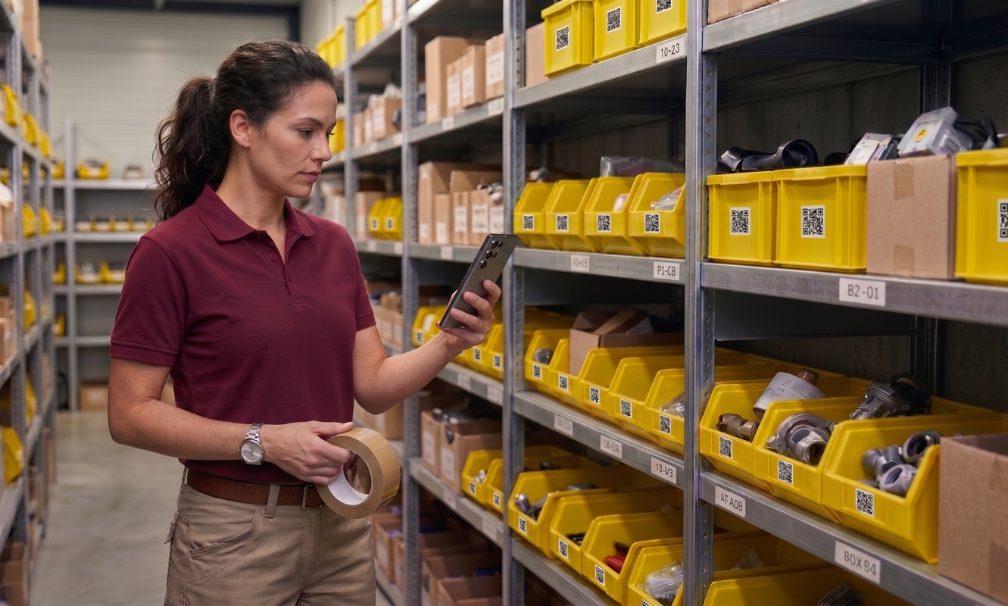
With BarTrack, all of this information is stored in one central system. Employees no longer have to rely on colleagues to locate materials. Through the app, desktop, or web platform, they can instantly see where items are stored and how many are available.
As a result, new employees can become productive and work independently much more quickly.
How BarTrack captures and preserves knowledge
BarTrack helps companies turn warehouse knowledge into a standardized process.
Every storage location is assigned a unique inventory label. Materials are linked to these locations, making it easy to see exactly where every item is stored. Whenever materials are moved, issued, or returned from a project, the change is recorded immediately.
This creates a digital map of the warehouse that is accessible to everyone.
A technician who needs an item no longer has to ask a colleague where it is. They simply search for the item in BarTrack and instantly see its storage location.
Planners benefit as well. They can check material availability in advance instead of relying on assumptions or verbal communication.
As a result, warehouse knowledge is no longer stored in the mind of a single employee—it is securely documented in BarTrack.
A stronger business starts with less dependency
The best warehouse employee in your organization has likely built up years of valuable knowledge. That knowledge is an asset and deserves to be preserved.
But an organization becomes stronger when its processes are not dependent on a single person.
By documenting storage locations, material movements, and inventory information in BarTrack, you create a warehouse that is easy for everyone to understand. New employees can get up to speed more quickly, materials are easier to find, and business continuity improves.
Because the question isn't whether that experienced employee will be absent one day.
The real question is: are you prepared for it?
Summary
Many companies rely on a single warehouse employee who knows exactly where materials are stored. When that employee is absent, delays, duplicate orders, and unnecessary searching quickly become common. With BarTrack, storage locations, material movements, and warehouse knowledge are centrally documented. This makes critical information accessible across the organization, creating a warehouse that no longer depends on one person, but is supported by a reliable, efficient, and future-proof process.



 Joelle Hablé : Jul 16, 2026, 4:24:58 PM
-1.png)
 Bart Grol